Photo: Vincent Dixon
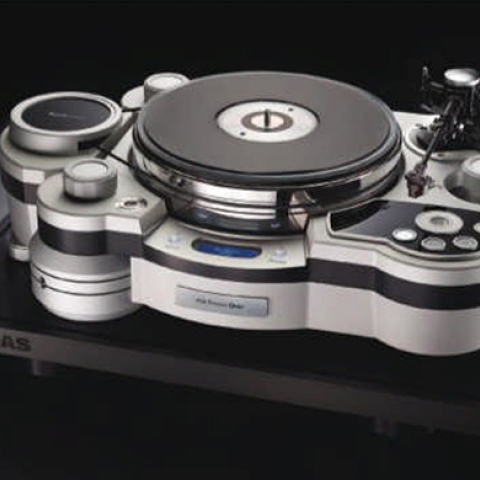
If you're going to spend a year-plus in COVID lockdown, it doesn't hurt to have a million dollars' worth of turntables keeping you company, right? That's been my good fortune. Sounds like a roomful, but it's only three: the SAT XD1, the TechDAS Air Force Zero, and the OMA K3 ($360,000, footnote 1).
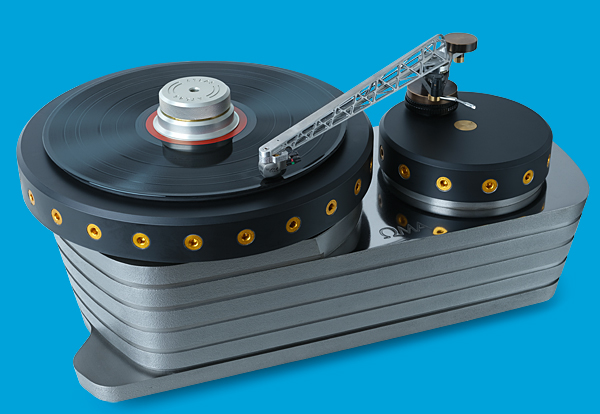
You'll find this issue's cover girl either strikingly beautiful or homely. Visitor reactions fall strongly into one of those two camps, with nothing in between. I love the looks. Whatever your opinion, the K3's visual distinctiveness cannot be denied. The innards are equally unique.
Looking somewhat like the Guggenheim Museum topped by a heliport and a construction crane, the cosmetically finalized K3 arrived, coincidentally, in the afternoon of a day in which OMA's Jonathan Weiss spent the morning at the actual Guggenheim Museum, installing an array of his OMA Fleetwood Line of loudspeakers in support of "Anthem," artist, filmmaker, and MacArthur Grant recipient Wu Tsang's new commission, conceived in collaboration with singer, composer, and transgender activist Beverly Glenn-Copeland (footnote 2).
Much like the gestation of the Continuum Caliburn, the K3's design development and construction resulted from an almost-seven-year international cooperative effort involving industrial-level manufacturing acumen and academic expertise. Auckland, New Zealand–based hydraulics engineer Richard Krebs led a group that also included a Bucknell University team of professors and graduate students from the departments of engineering and physics. Also on the team are tonearm designer Frank Schröder (a familiar name to most Stereophile readers), architect/industrial designer Ana Gugic, and of course Jonathan Weiss, who in 2006 founded Pennsylvania-based OMA, short for Oswalds Mill Audio. While the company is best known for its compression-horn loudspeakers and tube electronics, OMA has from its inception built custom direct-drive turntables using Technics SP10 variant motors set in a variety of massive, well-damped plinths made mostly of Pennsylvania slate and more recently of hypoeutectic gray cast iron; I enthusiastically reviewed one of those a few years ago.
Photo: Cynthia van Elk/OMA
Mr. Krebs and Jonathan Weiss gave me separate accounts of the K3's design background, which not surprisingly included the K1 and K2 iterations. The concept derives from vintage vinyl-cutting lathes, which Weiss pointed out were "designed as very expensive tools, built on the level of extreme-precision scientific, laboratory instruments."
Cutting lathes were almost always made of cast iron; in the case of Neumann lathes, even the 66lb platters were cast iron. All were direct drive. To learn more about cutting lathe construction, refer to pspatialaudio.com/lathes.htm. The K3's massive cast plinth structure, the design of which was aided by finite-element analysis (FEA) performed at Bucknell, is said to be critically damped, which means no oscillation and the fastest possible approach to equilibrium. The casting is of the aforementioned high-graphite-content hypoeutectic gray iron. The plinth, the platter, and the circular armboard all feature internal chambers (the plugs of some of which are visible around the platter and armboard periphery) filled with a mixture of a special oil and particulate matter designed to deaden vibrations and kill resonances. The platter hides a matrix of vertically oriented chambers filled with this oil-and-particulate mixture, all located based on the FEA analysis.
The direct-drive motor is a "bespoke" 18-pole, coreless-slotless, zero-cogging design based upon rotors and stators purchased as parts (after a six-month search for the right ones) and assembled with large neodymium magnets to produce what OMA says is "the most powerful motor ever used on any turntable." OMA says it's more powerful than the Lyrec motor used on Neumann lathes. OMA also says it has developed superior motors to drive lathes, but that's a story for another column.
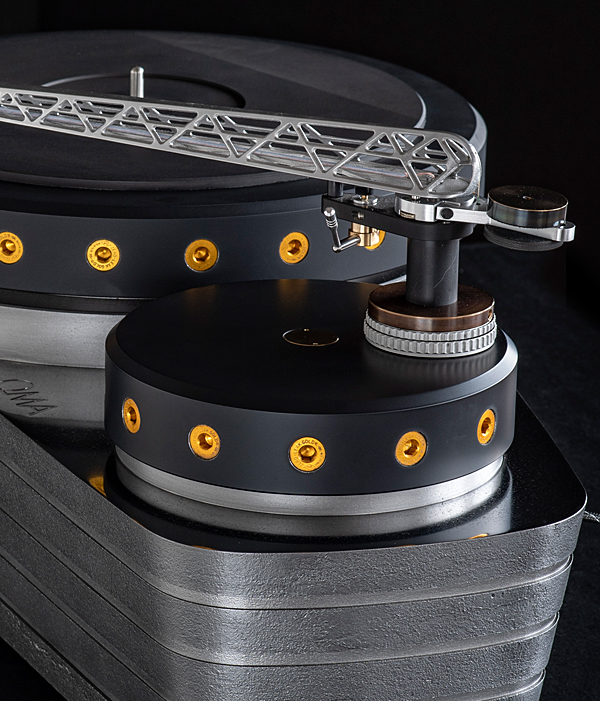
Photo: Cynthia van Elk/OMA
In this ingenious design, the stator clamps securely to the massive chassis bottom, which then becomes the motor housing. The rotor attaches to the bottom of the bearing sleeve. An unusually large-diameter (25mm, almost 1") hardened stainless steel alloy shaft bolts directly to the chassis, helping to maintain a high level of dimensional accuracy between the rotor and stator and between the platter and the armboard.
The unusually long bearing puts the powerful motor magnetics, which are located at the bottom of the platter/ bearing assembly, farther away from the cartridge than is typical on direct-drive designs.
OMA was after exceptional dynamic speed stability; the goal was a system that would perform optimally while playing a record. Krebs said that, with finesse, higher motor torque makes it easier to precisely manage speed fluctuations under dynamic conditions.
Footnote 1: OMA/Oswalds Mill Audio, Fleetwood, PA, with a showroom in Dumbo, Brooklyn, NY. Tel: (917) 743-3789. Web: oswaldsmillaudio.com. Footnote 2: See guggenheim.org/wu-tsang-anthem. Footnote 3: Unless someone has made a bigger one in the last few years, the largest known molecule is PG5, which has a diameter of 10nm, or 0.01 microns.—Jim Austin Footnote 4: Sounds weird I know, but it's an actual thing: 3D-printed sand molds.